Sunday, April 20, 2014

This Little Biz Went to Market


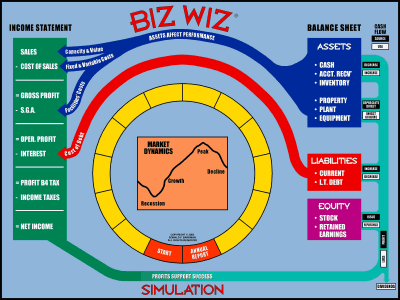
Today in Social Studies Methods for Childhood Education, my class and I continued to explore the education of economics at the elementary level. We were split into groups of 3-4, each of which received a kit for BizWorld, BizWiz, or BizMovie. Once in groups, our teacher also had us decide whether we wanted to create an animated movie from a  debate, conversation, or commercial view for our kits. My group and I were given BizWiz and chose to do this program through a conversational viewpoint. We did this by creating an animated film using GoAnimate.com. 

GoAnimate offers a variety of themes, scenes, graphics, sounds, and animations to really bring your video to life. However, you are limited to a 30 second video run time if you create a video as a free user. In order to get past this rule, I created a long draft video without saving. I then recorded the draft video using iMovie. Overall, I found GoAnimate very easy to use and think that I might buy it in the future. It is a very engaging way to teach anything, and my group and I had a blast creating a knowledge filled, humorous movie about parents being concerned with their son's teacher using BizWiz in the classroom. I hope that the video below teaches you all about BizWiz while also showing you how wonderful GoAnimate is when it comes to engaging students. ENJOY!


Saturday, April 5, 2014

Engaging Economics Throughout Education


Children get introduced to the concept of money at a very early age. We give them toy cash registers and piggy banks, and allow them to play games like Monopoly. Children love money, but do not understand its limitations. They do not grasp why mommy can't buy them everything in the store or how money earned compares to money spent. This concept of monetary value is usually something that children begin to grasp in school through such topics as career education, geography, history, community studies, and consumer education.

How is Economic Education integrated throughout the Social Studies Curriculum through these topics? 

Career Education: Explores career choices by comparing the cost of a degree or certification, school time, salary, and benefits to other careers. For instant, how much money and time does it take to become a doctor? Does the salary and benefits outweigh the time, energy, and money put into creating this career for oneself? 

Geography: Promotes an understanding of how geography plays a major role in economics by providing examples of the benefits and limitations of different locations around the world. This focuses on aspects like natural resources, biodiversity, natural disasters, climate, human interactions, transportation, mobility, international trade, and globalization and how they affected the economical development of a particular area. 

History:Gives the knowledge of what life was like without money in order to get students to really understand how money facilitates production, distribution, and consumption. History also provides information on how monetary value influenced culture,religion, recreational activities, and more throughout the world. 

Community Studies: Provides examples of community, city, country, continent, and world interdependence within economics in order to understand the importance of working together in order to achieve an overall stability throughout all aspects of life.

Consumer Education: Discusses the importance of consumers by providing information of how these consumers create the economic system of a nation. Within Consumer Education, it is also discussed that the main goal is to make the consumer happy in order to ensure that they will continue to buy the products of a particular individual or company. 


Example of Economics being taught through History


Geography and Economics

Money from around the world does not hold the same value. Many different factors go into deciding the worth of money within different locations. This is known as currency. (click link for currency calculator)

Why is it that $1.00 of USA money equals $1.08 of Australian money?


Interactive Ways to Teach Economic Education 

Interactive way of understanding how consumers win because of  the competition of producers. 


Friday, April 4, 2014

Remains of the Past

Most people think that there is no way to making Social Studies interesting at any age level. The people that think this way are sadly mistaken. Though Social Studies might not be everyone's highly taxed cup of tea, there are certainly many ways to offer a more engaging way of teaching this subject. For instance, you might want to learn about how to create artifact bags!

In order to create your own artifact bag, you must first explore some of these questions:

-What is an artifact?
Artifact: An object produced or shaped by human craft, especially a tool, weapon, or ornament of archaeological or historical interest.

-What artifacts will I put into my artifact bag?

-Do these artifacts have significant meaning to the topic that I am going to explore?

-Will my students be able to figure out the who, what, where, when, and why  for each artifact in order to come up with a conclusion for their artifact bags?

-What am I looking for in a conclusion? What is my BIG question?


A computerized version of my Artifact Bag

Artifact Bag Topic: Thirteen Colonies, One Country
BIG Question: Who am I? (Tell students before giving them the artifacts) 

Artifact List:- Students should figure this out on their own. You might want to give them books or computers to use for research. 

1) Map of Boston, Massachusetts 
2) Horse Figurine 
3) Hat 
4) "No Britain" Sign
5) Fireworks
6) Silver Teapot

WHO AM I? ... PAUL REVERE 

Justification: Paul Revere was born in Boston, Massachusetts (Artifact #1) on January 1, 1735. After his father died, he took over the family's silversmith shop (Artifact #6). After seeing how unfairly the British were treating the colonists, Paul Revere wanted to help the colonies pull away from British control (Artifact #4). He took part in the Boston Tea Party (Artifact #6 can also apply here) , where the colonists poured all of the British tea into the harbor in order to rebel against the tea tax. The British were so angry that they decided to attack the colonies, but Paul Revere rode on horseback (Artifact #2) throughout the night to warn the colonists that "The British are coming, the British are coming!" He continued to play a significant role in American independence and we were able to create an independent nation, which we celebrate with firework displays (Artifact #5) every 4th of July. (Artifact #6 can be justified in pictures or by researching colonial clothing). 


Wednesday, April 2, 2014

The Dynamic Diné

Today,our Social Studies methods class once again explored the idea of Cooperative Learning. We went back to our original groups and each decided which Native American tribes we wanted to research. I chose to the Diné tribe and was put into an expert group with Julie, Julia, and Jean. 


When researching our tribe, we were supposed to really put an emphasis on how geography influenced the tribe. 

A distinctive Diné, also known as Navajo, culture came into play around 1100-1500 A.D. in the four corners area of the Colorado Plateau. On this Plateau, the Diné suffered from periods of drought, and wind and water erosion. They were also hit with undependable Summer rains, which often arrived as severe thunderstorms, and undependable Winter snow, which they relied on as a water source. However, the Diné people never backed down, so we gave them the following slogan:

"When the going gets tough, we get tougher."

With such unpredictable weather, the Diné tribe heavily depended on family ties to survive. They were an extremely unified group of people, who worked together to deal with all aspects of life. Though the land did not always work to their advantage, they still held a very high value of it because it played a big role in their survival. In fact, many games and traditions have emerged from their love of the land and their attachment to it. On top of this, they also have many typed of ceremonies that are focused on land and family.


We concluded that the geography of the Diné tribe promoted a love for their land and family. Though there were often harsh conditions, it is clear that this geography led to a highly unified, traditional, and loving group of people who who knew that working together created the amount of strength needed for survival. 

After teaching our classmates about our tribe, we then tested their understanding by taking a quiz on Kahoot. This was highly engaging and interactive and I will definitely be exploring this website more in the future. 

Friday, March 28, 2014

Teach Me How to CUBE!

Today, my group and I did our ten minute Current Events lesson. Though this lesson was implemented with college students, it was geared towards fifth graders. The video below was our way of engaging our targeted audience.


After engaging our ten students, we put two students in charge of each of  five of the viewpoints. They were able to look at how to do their viewpoint on our class forum: 

Description: 

After reading this article, you will describe what the article is about.

Comparison: 

After reading this article, you will compare your findings to a time when you were praised for something that you didn't think you deserved. 
Association:

After reading this article, you will associate what you read with something else that you have learned about, either in the news, class, or in your personal life.

Analysis: 

After reading this article, you will analyze the details that you read in order to break it up into four main parts.
 Application:

After reading this article, you will write down how you can apply the message that you learned to your own life.

Argumentation:

After reading this article, argue whether you believe that Faulkner did the right thing by asking for his Purple Heart later on in life or if you think it was too late? Why?


We then modeled how to do our cubing activity with the four following steps, using the description viewpoint. 

Step 1: Read Instructions for your viewpoint, so that you know what you are looking for when reading.
Step 2: Read an article.
Step 3: Write your viewpoint as a title and then compose about 3 sentence from your viewpoint.
Step 4: Tape your paragraph to our Super Cool Class Cube” 


My group and I chose an article called, 89-year-old U.S. WWII vet Richard Faulkner, which was about a veteran who wanted to receive his Purple Heart that he had turned down many years ago. He stated that he had turned it down because he didn't feel right accepting such an award after the death of all of his friends. However, after enough time to grieve, he realized that he wanted to have his Purple Heart to pass down to his grandchildren in memory of his military service. 

I have provided the link to the article here: http://www.studentnewsdaily.com/blog/quote-of-the-week/89-year-old-u-s-wwii-vet-richard-faulkner/


Cubing Activity Completed


We concluded the lesson by having students discuss their viewpoints and how it felt to have to look at something in a different way. We also related the topic back to school, work, social lives, and personal lives. The end goal was to get students to understand that being able to look at things from a different perspective is very important in all aspects of life. I think that we succeeding in meeting this goal and that the activity a whole went very well. 

Three Likes: 
1) The students found our PowerPoint Presentation and "Super Cool Class Cube" to be engaging.

2) All of the students got to be part of this activity and got a chance to talk about their viewpoint

3) We were able to relate the ideas of viewpoints back to personal lives, school, jobs, and social lives. 

~*~*~A Wish ~*~*~

** I wish that we had more time to do this activity **

Monday, March 24, 2014

You Can't Finish a Puzzle Without Every Piece

 About a month ago, my classmates and I were divided up into three separate groups. In our original groups, we each picked a topic on Cooperative Learning. Being that I chose to do Cooperative Learning Lesson Planning for my original group, I was then put into an expert group with the other groups' members who chose to do Cooperative learning lesson planning. The three of us then worked together to become experts within our topic, so that we could later teach our own groups about Cooperative Learning lesson planning. This method is known as the Jigsaw Method. In education today, the idea of group work is very valued because there is so much evidence to show that students learn best from each other.  
             

Because of the horrid weather and the interruption of fieldwork, we had to postpone the portion of jigsaw puzzle where each expert  taught their topics to the members of their original groups. Today, we finally got to present, and I began my presentation by activating prior knowledge and pre-assessing my peers orally. After seeing how much they already knew, I then moved on to talk about some tips for Cooperative Learning lesson plans, such as, the importance of making sure that your students know what is wanted from them, both socially and academically. You want to make sure that students are being respectful towards one another, being good listeners, using indoor voices, and focusing on their specific role. You also want to make sure that your objectives are understood and manageable for all students, while also ensuring that those objectives are congruent to your activity. Lastly, it is very important to choose your groups wisely. You should never leave this up to chance, and you should make sure that you are putting students together who will benefit one another. 

After this, I went over the five steps of Jigsaw: Choosing a lesson, making pre-instructional decisions, explaining the task and cooperative goal structure, monitoring and intervening, and processing and assessing. You can learn about these more in depth by viewing our Cooperative Learning Lesson Planning Slideshow. {To see our complete slide show, Click here }

After doing this, we reviewed a Cooperative Learning lesson plan template specific to Mount Saint Mary College. We did not have time to watch the video below, but I feel that it implements a Cooperative Learning lesson plan very nicely. I also did not have time for our "Cool Down" to assess how much my peers learned, but it is in my slideshow. 


Friday, March 21, 2014

Expanding to the West...

This week was a last first. It was the last first time that a group would begin their lessons. This was bittersweet because I was excited to see what a wonderful lesson group four had for us, but it also hit me that this meant we would be leaving the second grade class soon. Ms. Julie. Mr. Kimbark, Ms. Rachel, and Ms. Jessica started the class with a review of what the students had learned from the previous three groups (Indians, Pilgrims,  & Thirteen Colonies). They then moved forward and presented a PowerPoint  on Western Expansion under Thomas Jefferson's presidency. There was a special focus on Lewis and Clark, who were explorers that really paved the way towards Western Expansion. They also pointed out several other key details and terms, which they later based their cross word puzzle on for independent practice. 


For their Inquiry lesson, the teachers had a very well planned dialog that presented the problem and engaged the students. The three girls each gave their points as to why they believed a certain form of transportation was the best way to expand Westward until Mr. Kimbark stated that they should ask the second graders for help. The second graders were then split up into three groups: railroad, boats, and horse drawn wagons. They had to look up information and then present why their mode of transportation was the best. The students were highly engaged and so well behaved during this activity. 


During the final lesson, the teachers did an absolutely amazing job by having groups create scrapbooks. The students pretended to be Lewis and Clark in order to write letters explaining their journey, figure out what to bring on their journey, and writing down all of the things that they might have seen. 


*FIREWORKS* to Ms. Julie. Mr. Kimbark, Ms. Rachel, and Ms. Jessica. You all did such a wonderful job with your three lessons!